Heirloom & Open Pollinated Corn Seeds

All natural heirloom & open pollinated corn seeds.

Free Shipping in USA

Heirloom & Open Pollinated Corn

All seeds are grown 100% naturally.
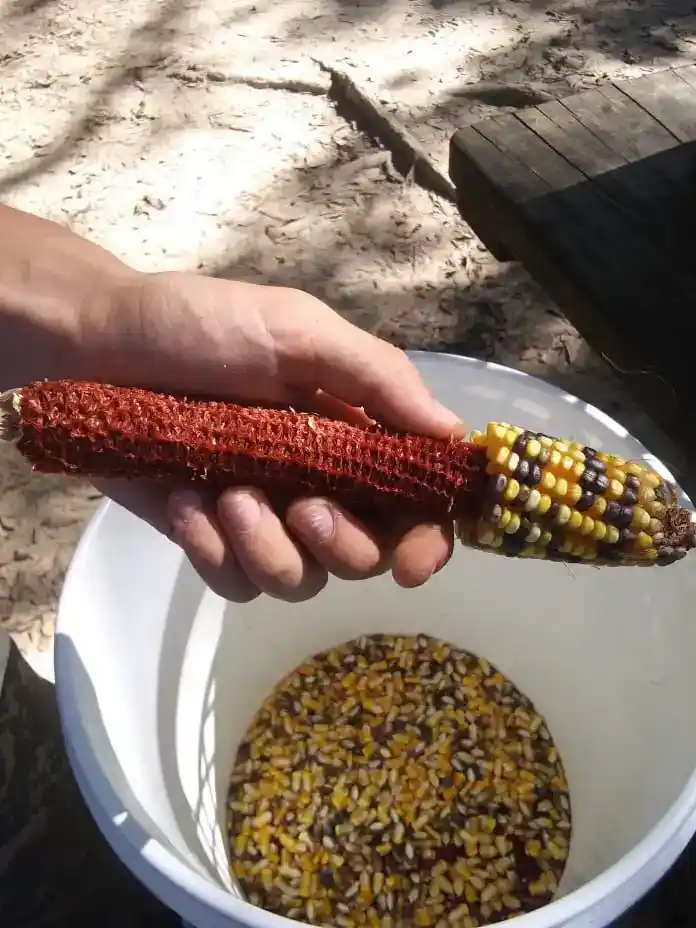
Wiggins Corn

Wiggins Corn (field, flint type)

(Zea mays)
100 seeds
SKU: WIG-1 100

This is a very special, rare variety flint type field corn.
Multi colored (white, yellow, blue, & red).
High resistance to weevils in storage.
By far the best grinding corn for cornmeal and grits around.
Large diameter, 14 inch long cobs.
Tall (12 feet or higher) stalks that are some of the most resilient to wind lodging of any variety of corn we have grown, despite being so tall.
Direct sow in garden or field in spring 8 inches apart in rows. Corn is wind pollinated so it is imperative that it be planted in a block of at least 5 rows. Corn can handle a frost, but may not germinate well in cool wet soil.
100 days
Harvest fresh for corn on the cob (even though its a field corn, it is still delicious when harvested young), or wait until it dries on the stalks.


$7.99

Double red sweet corn

Double Red Sweet Corn (Sweet, SU, Normal Sugary)

(Zea mays)
100 seeds
SKU: DRC-1 100


This rare open pollinated sweet corn variety is truly one of a kind! As far as red corn goes, double red is as dark as it gets (almost purple to black). In fact, the plants are so loaded with anthocyanin pigments that the leaves, stalks & husks are deep red as well. Anthocyanin pigments are a natural source of anti-oxidants & act as an anti-inflammatory.
5-7 foot tall plants produce 1 to 2 ears per stalk.
Direct sow in garden or field in spring 8 inches apart in rows. Corn is wind pollinated so it is imperative that it be planted in a block of at least 5 rows. Corn can handle a frost, but may not germinate well in cool wet soil.
85 days
Harvest fresh for corn on the cob, or wait until it dries on the stalks for grinding (makes good cornmeal or grits too!).

$7.99

Bulk 400 seeds = $25

Hopi blue corn

Hopi Blue Corn (Flint, Flour, Cornmeal)

(Zea mays)
100 seeds
SKU: HBC-1 100


This rare heirloom flint corn is an ancient variety valued for its super high protein content. Used as a roasting corn when harvested young, Hopi Blue is traditionally dried & ground into flour or cornmeal for blue corn tortillas, chips, & other baked goods.
5-8 foot tall bushy plants produce 8-9 inch ears.
Direct sow in garden or field in spring 8 inches apart in rows. Corn is wind pollinated so it is imperative that it be planted in a block of at least 5 rows. Corn can handle a frost, but may not germinate well in cool wet soil.
110 days
Harvest fresh for corn on the cob, or wait until it dries on the stalks for grinding.

$5.99

Bulk 400 seeds = $22


Oaxacan Green Corn

Oaxacan Green Dent
Corn

(Zea mays)
100 seeds
SKU: OGC-1 100

Beautiful iridescent emerald
kernels on 7-10 inch cobs. Tall
stalks often reaching 10 feet in
height are vigorous growers.
Used to make green corn meal
& masa for tortillas, chips &
tamales.
Direct sow in garden or field in
spring 8 inches apart in rows.
Corn is wind pollinated so it is
imperative that it be planted in
a block of at least 5 rows. Corn
can handle a frost, but may not
germinate well in cool wet soil.
95 days


$7.99

Bulk 400 seeds = $25


Corn
Domesticated by indigenous peoples of Southern Mexico about 9000 years ago from teosinte (wild corn, listed in this catalog), corn (maize) has become a staple in many regions around the world. Maize is the term used for the domesticated variant of teosinte, & although many theories were proposed throughout history of the origin of maize it wasn’t until 2004 that John Doebley identified Balsas teosinte, native to the Balsas River valley in Mexico's southwestern highlands, as the crop wild relative genetically most similar to modern maize.
Corn has many uses & perhaps is a little overused in commercial food production in countries like the United States, but for the homesteader corn is a valuable crop with many uses nonetheless. From corn on the cob & cornmeal to hominy, alcohol, bio-fuel & animal feed, corn is as useful as it gets when it comes to living in a self reliant manner.
There are three distinct groupings of corn varieties you will encounter in this catalog. Flint types, dent types, & sweet corn. 
Flint corn varieties are used primarily for grinding due to their extremely hard kernels & are considered a field corn. Flint corn is also the most impervious to weevil damage in storage due to its hardness. 
Dent types are a field corn used for grinding as well, but also impart themselves to eating fresh when harvested at the right time & are great for animal feed. Dent types are characterized by a small dent on the bulbous end of the kernel. 
Sweet corn is used primarily for fresh consumption as corn on or off the cob. One interesting fact about sweet corn is that its sugars convert to starch rapidly post harvest or if left on the stalk too long. Within just a matter of minutes from harvest, much of the stored sugar is lost to this conversion. Old timers used to (& wise folks still do) plant sweet corn close to the kitchen so the cobs can be harvested after the water is already boiling & cooked as quickly after harvest as possible. This is the only way to enjoy fresh sweet corn at its finest. Store bought sweet corn could never compare to that grown in your own garden!
Corn is wind pollinated & it is imperative that it be planted in blocks at least five rows wide. If planted in a single row, pollination will hardly occur & you will be left with empty cobs void of edible kernels. This is the number one mistake beginning gardeners make when attempting to grow corn for the first time.
Corn will germinate in soil temperatures as low as 50°F & is not incredibly sensitive to frost or even a light freeze, but the ideal soil temperature for optimal germination is much higher (85°-90°F). Allowing soil temperatures to achieve at least 65°F at the planting depth of one to two inches is the compromise that should be made if possible.
Plant corn in rows spaced twenty four to thirty six inches on centers, anywhere from five to nine inches apart. Two to three seeds should be planted in each hole. High population density has its advantages when it comes to adequate pollination as well as stability in high winds, but personal preference varies from one gardener or farmer to the next. We prefer to plant three seeds per hole, nine inches apart, in rows spaced thirty six inches on center.
There are a few pest & other conditions that can affect your corn crop in a negative way, but the one that stands out & causes the most damage are corn earworms. Corn earworms can be controlled to some degree with the application of the bacterium Bacillus thuringiensis (BT). BT can be found in liquid form & sprayed on the plants. The downfall when it comes to BT is that the bacterium has to be consumed by the insect to take effect, meaning that at least some damage will occur prior to controlling the pest.

Our Mission

"Mississippi Foundation for Renewable Energy's mission is to promote sustainable lifestyles. We accomplish this by providing informative assistance in the form of consultation, as well as providing a unique product line geared toward homesteaders & "big city" dwellers alike. We are world leaders in off-grid renewable energy & alternative communications system design. We support the preservation of natural, non-GMO, open pollinated plant life, & donate tens of thousands of seeds each year to seed library programs across the USA. All proceeds from our website https://www.backwoodsenergy.org are utilized in our effort to fulfil our mission of promoting sustainable lifestyles worldwide." 

Days Until Spring (vernal equinox)

Help us spread sustainability
Share this Page!

Contact us

Our customer support team is here to help you.

Email

We will reply as soon as possible.

Phone

We work hard & can't always get to the phone, so leave us a message & we will call back as soon as possible.